


Last Updated: October 31, 2026
Quick Summary
Spot quality personalized jewelry by checking the hallmark, smooth edges, tidy soldering, and secure stone settings, then judge the personalization itself: deep engraving, level lettering, clean cut edges, and solid attachment points. Confirm the metal type and approve a proof before production, since most sellers cannot change a name once it is cut or engraved.
- Look for a 925 stamp on sterling silver and 14K or 18K on gold, usually on the clasp or pendant back.
- Deep engraving shows clear shadow inside letters, while shallow laser marking looks flat and faint.
- A 9mm lobster clasp is used on the name necklaces in the CoziBloom collection.
- Put jewelry on last, after lotion and perfume dry, and remove it before exercise and showers.
- Rings with continuous engraving or a full name band may not be resizable without interrupting the design.
Table of Contents
- How to Inspect Personalized Jewelry Up Close
- Quality Jewelry Materials: Solid Gold, Sterling Silver, and Plated Options
- Jewelry Craftsmanship: What Separates Hand-Finished from Mass-Produced
- Jewelry Chain and Clasp Quality: The Parts That Fail First
- How to Care for Personalized Jewelry So It Lasts
- Shop Personalized Jewelry with Confidence at CoziBloom
- Frequently Asked Questions
How to Inspect Personalized Jewelry Up Close
Learning how to spot quality personalized jewelry comes down to a few close-up checks.
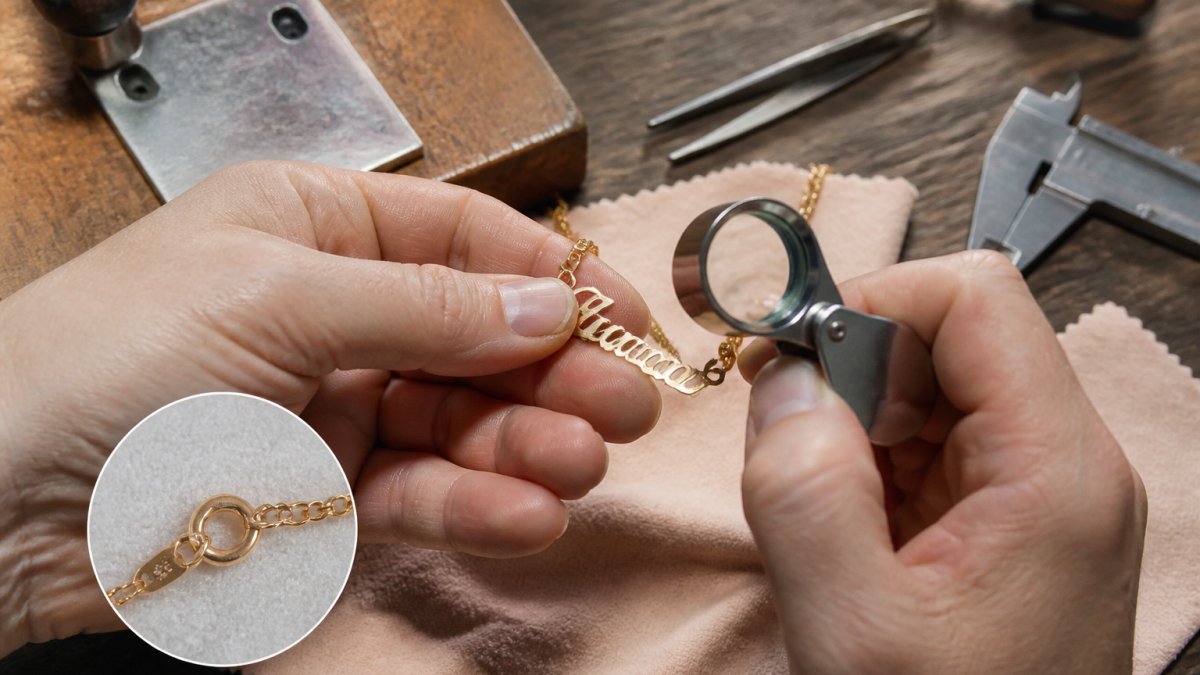
Custom name necklaces, initial pendants, and engraved keepsakes are popular gifts, and the difference between a piece that lasts and one that tarnishes usually shows up in the small details.
Here are the exact checks to run before you buy, in a store or zooming in on a product photo.
Check the Hallmark and Purity Mark
A hallmark is a small stamp that tells you the metal content and where the piece was made.
Where to look: the clasp, the inside of a ring band, or the back of a pendant.
A maker's mark and country of origin should sit near the purity mark. If a seller can't tell you what the stamp says, that's a warning.
Look for Smooth Edges and Clean Soldering
Run a fingertip along every edge. Quality personalized jewelry feels smooth, with no burrs or rough spots that catch on skin or clothing.
Soldering is the join where metal meets metal. Good soldering is nearly invisible; bad soldering shows as lumpy blobs, dark pits, or gaps.
Check these spots:
- Where the pendant meets the chain loop
- Where a nameplate letter connects to its neighbor
- Where a clasp attaches to the chain end
If a joint looks uneven or shows a gap, the piece will likely snag, bend, or break there.
Quality Jewelry Materials: Solid Gold, Sterling Silver, and Plated Options
The material decides how long a piece lasts. Solid gold and sterling silver hold up for years.
Here's how the main options compare:
| Material | What It Is | Durability | Best For |
|---|---|---|---|
| Solid gold | Gold all the way through | Highest | Heirloom pieces, daily wear |
| Sterling silver | 92.5% silver, stamped 925 | High, may tarnish | Everyday necklaces, gifts |
| Gold-filled | Thick gold layer over base metal | Good | Budget-friendly daily wear |
| Gold-plated | Thin gold layer over base metal | Lower, can fade | Occasional wear, lower budget |
A common mistake is assuming "gold" on a label means solid gold. Plated, filled, and solid are all different, so ask which one you're getting.
Watch out: plated pieces can fade at the clasp and pendant loop first, because those spots rub against skin and fabric all day.
Jewelry Craftsmanship: What Separates Hand-Finished from Mass-Produced
Craftsmanship is the sum of small decisions: how a letter is cut, how a surface is polished, how a stone is set. Mass-produced pieces often skip the final hand-polish, and you can feel the difference. For personalized jewelry, craftsmanship has a second layer, the customization itself. A name necklace or engraved pendant has to be judged on both how it is built and how accurately the personalization was executed.
General craftsmanship checks
- Even polish. A good finish reflects light evenly. Dull patches, swirl marks, or a cloudy haze mean a rushed polish or a skipped final buff.
- Clean interior surfaces. Turn the piece over. The back of a pendant and the inside of a ring band should be finished, not left rough or scratched.
- Secure stone settings. Prongs should grip the stone evenly with no wobble. Gaps under the stone mean it can loosen. Run a fingernail gently around the setting, a stone that shifts is a stone that will fall out.
Personalization-specific craftsmanship checks
This is where personalized jewelry separates itself from generic pieces.
Lettering alignment and spacing. On a nameplate or initial pendant, every letter should sit level on the same baseline and be evenly spaced.
Spelling and character accuracy. Before production, confirm every name, date, initial, and special character. Accents, apostrophes, hyphens, and numbers are common failure points.
Proofing before production. A good seller will show you a digital proof or mockup before production starts.
Judge the real thing, not the studio shot
When shopping for personalized jewelry, look for close-up photos of finished pieces rather than only studio shots, so you can judge how the personalization looks.
Jewelry Chain and Clasp Quality: The Parts That Fail First
Chains and clasps fail before anything else. The pendant may be beautiful, but a weak clasp turns it into a lost item.
Classic Paw Print Name Necklace →
Check the chain by holding it up and looking for kinks, stiff links, or uneven spacing. Examine an adjustable sterling silver chain bracelet up close.
For clasps, here's what to know:
- Lobster clasp: secure and easy to use, the standard for necklaces
- Spring ring: common but weaker, can bend open
- Magnetic clasp: convenient but can pop apart under load
The name necklaces in our collection use a 9mm lobster clasp.
Test the clasp yourself: open and close it a few times.
How to Care for Personalized Jewelry So It Lasts
Care is simple, but it decides whether a piece looks new in five years or dull in five months. The main enemies are sweat, water, perfume, and rough handling. Personalized pieces can add complications: engraving can wear down, and plated finishes can fade over time.
Daily care habits
Follow these habits:
- Put jewelry on last, after lotion and perfume have dried
- Take it off before exercise, showers, and swimming
- Wipe it with a soft cloth after wearing
Sweat reacts with silver and gold plating, so removing pieces before a workout protects the finish. For engraved pieces, avoid abrasive polishes and rough cloths that wear down lettering. A soft, non-abrasive cloth is enough for routine cleaning; reserve polishing compounds for plain metal away from engraving.
Care specific to engraved and personalized pieces
Protect the engraving. Deep engraving holds up well, but shallow laser marking and printed personalization can fade with repeated rubbing.
Watch the attachment points. On name necklaces and dangling initial pendants, the connection between the personalization and the chain is the highest-stress point.
Store personalized pieces separately. A nameplate can snag on chains, and engraved surfaces can scratch against other jewelry.
Repair and resizing limits
Personalized jewelry is harder to repair than plain pieces, and it is worth knowing the limits before you buy:
- Resizing. Rings with continuous engraving or a full name band may not be resizable without interrupting the design. Ask before ordering whether the ring can be sized later.
- Replating. Plated personalized pieces can often be replated, but the engraving may need to be re-cut or re-marked afterward. Ask whether replating is offered and what happens to the personalization.
- Chain replacement. A jeweler can usually replace a failed chain, but matching the original style and color takes care. Keep the original clasp and chain details on file.
If a clasp loosens or a stone wobbles, fix it early. Small repairs are cheap. Replacing a lost pendant is not.
Proofing and production: your last clean checkpoint
Before production begins, review the proof carefully. Verify spelling, font, size, metal, chain length, and any dates or initials. Read names letter by letter. Ask what can and cannot be changed after approval, most sellers cannot alter a name once the piece is cut or engraved. Keep a copy of the approved proof; it is your reference if the finished piece does not match.
A quick online-purchase inspection checklist
When buying online, run this checklist before you order:
- Confirm the metal and purity (solid gold, sterling silver, gold-filled, or plated)
- Ask for close-up photos of the engraving or lettering, not just the full piece
- Check that the seller shows real customer photos of finished personalized pieces
Shop Personalized Jewelry with Confidence at CoziBloom
Buying personalized jewelry online comes down to trust: clear materials, honest photos, and a seller who shows you what you're getting.
Our collection features thoughtfully curated gifts sourced from selected suppliers. Browse by recipient and occasion to find the right gift, and add gift wrap with a personalized message to complete the moment.
Ready to find a piece worth keeping? Get started with CoziBloom and give a gift that shows you care.
Frequently Asked Questions
What should I look for when buying personalized jewelry?
Check the metal stamp first: look for 925 on sterling silver or 14K/18K on gold. Run your finger along the edges to feel for roughness, and inspect the jump ring and clasp for secure soldering. Ask whether the piece is solid or plated, and confirm the personalization is engraved rather than printed. A reputable seller will share close-up photos of real customer orders so you can judge quality personalized jewelry before you commit.
How can I check the quality of a jewelry chain and clasp?
Hold the chain up to the light and look for even links with no gaps. Gently tug the clasp to test tension; a lobster clasp should snap shut firmly without wobble. Check the jump ring where the chain meets the pendant, since that is the weakest point. A thin chain under 1mm may not support a heavier nameplate. For daily-wear pieces, choose a soldered jump ring and a clasp rated for the pendant's weight.
Does personalized jewelry tarnish or fade?
Solid gold and sterling silver develop patina over time but can be polished back to shine. Gold-plated and gold-filled pieces can fade with friction, sweat, and perfume, so remove them before swimming or showering. Deep engraving holds up better than surface printing, which can wear away. Store each piece in a dry pouch, and clean with a soft cloth. With basic care, quality personalized jewelry keeps its finish for years.
Which metals are best for personalized jewelry?
Sterling silver (92.5% silver) and solid gold (14K or 18K) are the most durable choices for everyday wear. Gold-filled offers a thicker gold layer than plating and lasts longer. Polished stainless steel resists tarnish and suits budget-friendly gifts. Avoid plated brass for daily wear, since the coating wears through. If the recipient has sensitive skin, stick to sterling silver, solid gold, or stainless steel, and confirm the maker's mark and country of origin.
The real test of personalized jewelry isn't how it looks on day one. It's how it looks after a year of daily wear. Start with the checks above, buy from sellers who are clear about materials and craftsmanship, and you'll end up with a keepsake that lasts. CoziBloom is here to help you choose well, with thoughtfully curated gifts, honest product details, and options organized by recipient and occasion so the right piece is easy to find.


